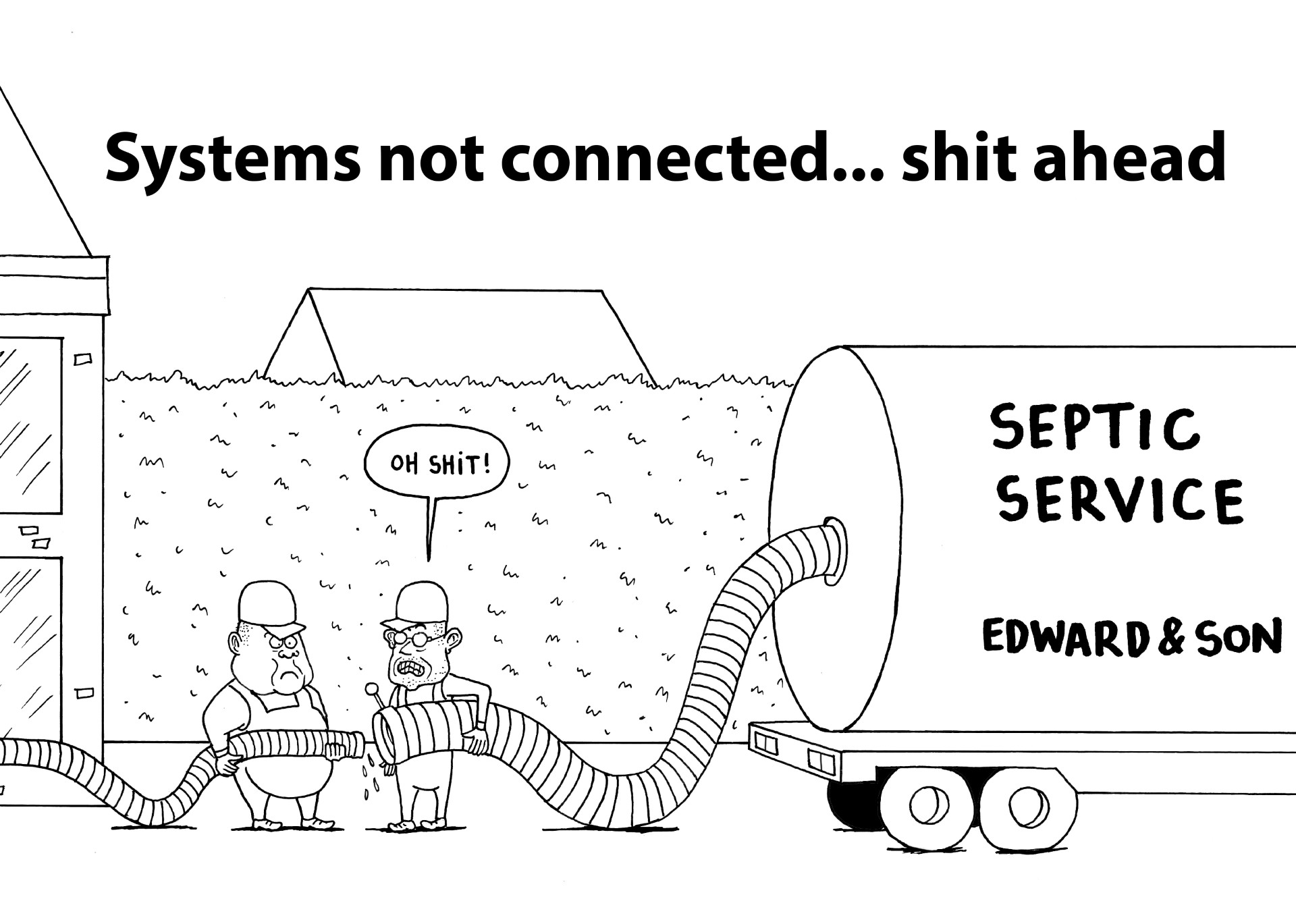
Companies today run more IT systems than ever before. From CRM platforms and ERP suites to HR tools, project management software, and financial applications - the average organisation relies on a growing stack of specialised tools, each promising to make work easier. And yet, one of the most common frustrations heard across teams and industries remains the same: these systems don't talk to each other.
It's a problem that feels like it shouldn't exist. After all, most popular software vendors boldly advertise integrations and connectivity as a core feature. So why, in practice, does data still live in silos? Why are employees still copy-pasting between systems, manually re-entering the same information, and catching errors that should never have happened?
The real cost of disconnected systems
When systems don't connect, the consequences are felt every day. Double maintenance becomes the norm -the same data is updated in one system and then again in another. Human error creeps in during those manual hand offs. Teams waste hours on work that should be automated. And perhaps most insidiously, frustration quietly builds, eroding trust in the very tools that are supposed to help.
It's not a technical problem
Here's the uncomfortable truth: in most cases, connecting systems is technically feasible. The real barrier is something far more foundational: a lack of shared data knowledge across the organisation.
For two systems to exchange data reliably, they need a common language. That usually means a shared identifier, a unique reference that means the same thing in both systems: a customer ID, a product code, a project number. Without it, there's no reliable way to match a record in System A with its counterpart in System B.
This is where many companies fall short.Different departments implement their own systems independently, often without consulting one another. A sales team configures their CRM one way; the finance team structures their ERP another. Nobody sits at the intersection of both, and so a common identifier never gets defined. The result is data fragmentation, not because the systems are incompatible, but because the data was never designed to connect.
The customisation trap
Standard software packages are rarely deployed out of the box. They get configured, extended, and customised to fit the needs of individual departments. Extra fields are added. Workflows are adjusted. Naming conventions drift from the vendor's defaults.
This isn't inherently wrong, businesses have unique needs. But it has a consequence: the more a system is customised, the less it resembles the standard version the vendor's connectors were built for. Off-the-shelf integrations increasingly fail to reflect how the software is actually being used on the ground.
The knowledge gap
Even companies that have invested in data lakes, platforms designed to bring all company data under one roof, often find that the underlying problem persists. Having all the data in one place doesn't automatically mean anyone understands what it means, where it came from, or how it relates across systems. People with a clear, cross-departmental view of company data are rare, and their absence is felt.
What can actually be done
The path forward starts with analysis, not more technology. Before reaching for yet another integration platform, organisations need to ask the right questions: What data do we have? Where does it live? What is being maintained twice? What does each part of the business actually need from the other?
That mapping exercise - done properly, with input from across the business - brings clarity. It surfaces the common identifiers that can serve as bridges between systems and reveals where duplication and friction are truly happening.
From there, a well-designed piece of custom software can provide a targeted, meaningful solution - not a generic connector, but something built around the specific data relationships and logic of that organisation. Done well, it eliminates manual effort, reduces human error, and turns daily frustration into something that simply works.
The systems were never really the problem.Understanding the data that flows between them is where the solution has always been.

